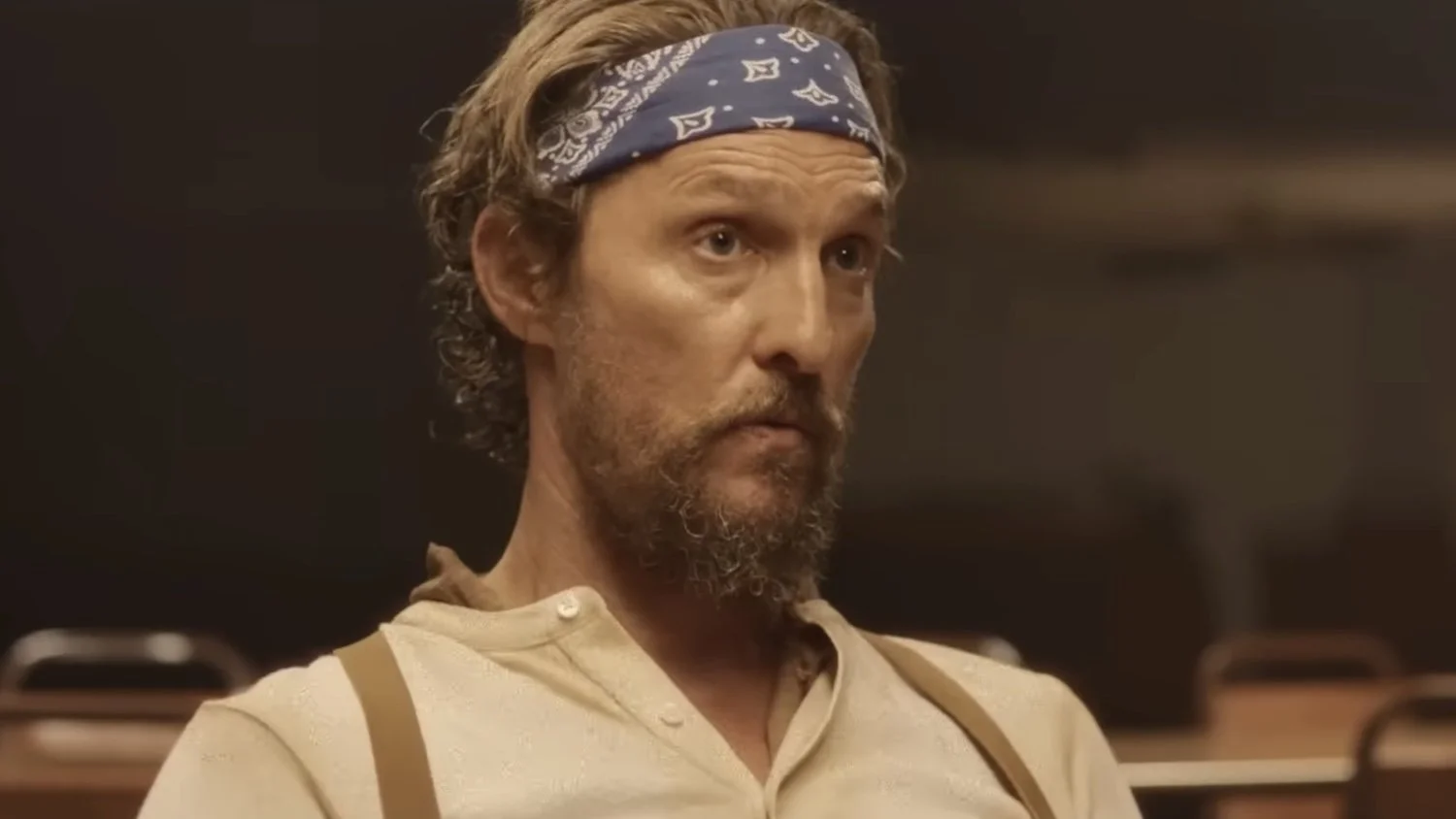
The Rivals of Amziah King
Andrew Patterson’s Vast of Night follow-up initially feels like a hangout movie, with joyous bluegrass musical interludes. The soundtrack is an A-plus. In terms of structure and pacing, it’s as if the first act is an hour long, and the real story doesn’t begin until halfway through the movie. Everything up to that point—even a freak accident that shouldn’t be spoiled—is just a celebration of life and community, as Amziah (Matthew McConaughey) dispenses folksy beekeeper wisdom to his foster daughter, Kateri (Angelina LookingGlass). From there, this highly unconventional film veers into a honey heist and revenge plot with questionable moral choices. As the tagline says, “Ain’t no one all good or all bad.”
A Prayer for the Dying
Sheriff Hansen (Johnny Flynn) sees his happy home life become a hellscape as diphtheria and wildfires converge on his town, post-Civil War. He’s a man who tries to do the right thing but makes all the wrong decisions, damning himself and others in the process. I was transfixed by the bleak, unflinching horror that unfolds, but for some viewers, it might be too much—or not enough. As Hansen’s reliability as narrator comes into question, the film unmoors the audience in rambling voiceovers and abstract imagery. The novel, written in the second person, is more upfront about his aversion to horses, for example. It explains straight-off that he “had to eat them” as a soldier. The movie hints at that, but the lack of lucidity in its storytelling brings to mind a Cool Hand Luke quote: “What we’ve got here is a failure to communicate.”
Hope
It’s a shame about those visual effects. I was a big fan of The Wailing, so I was really rooting for Na Hong-jin to succeed with what amounts to the most expensive Korean film ever made. But a monster movie is only as good as its monster. This particular feature withholds the sight of its creatures for the first 50 minutes. When we finally get a good look at one, even Jung Ho-yeon’s M16-toting deputy acknowledges that it’s a “goddamn eyesore.” At least the movie has a sense of humor about it. For the bulk of its runtime (and there is a lot of running), Hope gets by on that, its production design, and its adrenaline-fueled chase sequences. No amount of sci-fi action, however, can make up for the ending, which is a full-on train wreck (or spaceship wreck, as the case may be).
It Ends
Four young adults get stuck on a road with no turn-offs, where their car is threatened by monotony, meaninglessness, and other people desperate to escape. They never run out of gas and never need to eat or sleep, but routine still shapes their existence. It’s the road of life, and all they have is companionship to keep them going. While the movie could perhaps do more with its scenario, the central quartet helps sell it with their charisma and chemistry. Witness their primal screams on behalf of a generation inheriting a world where the future seems hopeless. Anyone looking for an off-ramp will find one in the title.
The End of Oak Street
Dinosaurs as domestic disturbances. That’s the elevator pitch. Mom and Dad are fighting, and the kids aren’t alright because their neighborhood has been transported back to prehistoric times. In the summer of 2026, you could be forgiven for thinking David Robert Mitchell—eight years removed from Under the Silver Lake—has somehow reinvented himself as more Spielberg than Spielberg. But he and cinematographer Michael Gioulakis, both FSU alums, are a little too overeager with all the split diopter shots. Still, Anne Hathaway adds dimension to her character as the matriarch of a dysfunctional family that’s got furry dinos intruding on its (literal) slice of suburbia.
Leviticus
The horrors of conversion therapy turn demonic for two Australian teens when a “deliverance healer” curses them to be hunted by the image of their desire. It’s not quite It Follows—more like It Throttles—but you could make the same criticism that it’s a bit loose with the rules it sets up. Will the monster only attack when characters give in to their desire? They inhabit a bleak Ozploitation setting where hate crimes and bad church music run hand-in-hand. You want them to escape and subvert the Bury Your Gays Trope, but the scares tend to evaporate when horror has a happy ending.
Disclosure Day
Feted by fans with film-critic pretensions, Steven Spielberg’s latest joint is talky, turgid, and too long by half. While the camera spins round and round, conjuring crop circles without purpose, it and the odd chase scene can’t disguise the essential lack of motion. The lens flares are distracting, the UFO footage is unconvincing, and the CG animals and aliens look cheesy. Colin Firth’s line, “Get on with it,” lands like a Monty Python joke. Emily Blunt is a dynamo, but her character’s plea to “Listen” feels naive for a movie this out of touch with the modern world.